What is a revenue operating system (RevOS)?
A revenue operating system is a single connected framework that runs a company's entire go-to-market motion, strategy, demand generation, business development, and sales enablement — as one system rather than a stack of disconnected tools, agencies, and teams. Where most B2B organizations run marketing and sales as separate functions with separate data, a revenue operating system treats revenue generation as one operating system: shared inputs, shared process, and a single source of truth from first touch to closed-won.
The problem it solves
Most B2B companies don't have a revenue strategy problem. They have a revenue fragmentation problem.
Ad spend lives in one platform. Call activity lives in a dialer. Leads live in a CRM that half the team doesn't trust. Marketing reports on MQLs, sales reports on pipeline, and nobody in the room can answer the one question the board actually asked: what did we spend to generate qualified pipeline?
Each function optimizes its own dashboard. None of them is accountable for the outcome that matters — revenue. That's not a tooling gap. It's the absence of an operating system that ties strategy, demand, business development, and sales together as one motion with one set of numbers everyone agrees on.
The four layers of a revenue operating system
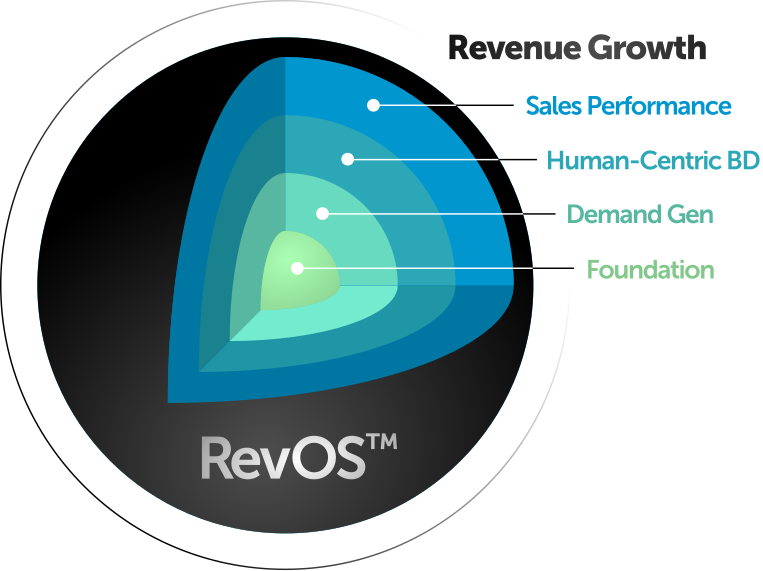
A revenue operating system is built from four connected layers. Each one has to work — and work together — for the system to function.
Foundation. This is everything that has to be true before you launch anything: positioning, ideal customer profile, strategic targeting, buyer personas, the buyer journey, a revenue plan, and the tech stack that supports it. Skip this layer and every dollar spent downstream is aimed at the wrong buyer.
Demand Generation. This is the revenue-lifecycle mindset applied to a buyer-centric experience — distribution across owned, paid, and earned channels, a MarTech stack that actually talks to itself, and real-time reporting that shows what's working while there's still time to act on it.
Human-Centric Business Development. This is where interest becomes a meeting: authority building, triggered-signal inbound and outbound, tech-enabled outreach, and constant measurement and optimization. It's the layer most companies underinvest in, and the one that determines whether demand gen's leads ever turn into a conversation.
Sales Enablement. This is marketing and sales working from the same playbook — scalable relationship selling, training, enablement materials, and the SalesTech to support it. Without this layer, even a full calendar of meetings gets closed inconsistently, if it closes at all.
What makes it an operating system
The four layers don't just sit next to each other — they amplify each other, and each one fails quietly without the others.
Demand gen without business development produces leads nobody works. Business development without sales enablement books meetings reps can't close. Sales enablement without a Foundation trains reps to sell brilliantly to the wrong buyer. A revenue operating system is the thing that makes sure all four layers are pointed at the same target, running on the same data, at the same time.
That's the difference between a system and a set of initiatives that happen to share a logo.
Revenue operating system vs. RevOps vs. a CRM
This is the question we get asked most, so here's the short version:
What it is | What it answers | |
Revenue operating system | The strategic framework — Foundation, demand gen, business development, and sales enablement, working as one system | What should we be doing, and why? |
RevOps | The function — the team and tooling that align data, systems, and process across marketing, sales, and customer success | Is our data and process clean? |
CRM | A database of record | Who did we talk to, and what happened? |
RevOps is the plumbing. A revenue operating system is the whole house. You can have a perfectly clean CRM, a fully staffed RevOps function, and still generate no pipeline — because none of those answer the strategic question of who you're targeting, how you're creating demand, or how interest becomes a closed deal.
How to tell if you need one
A few signs you're running fragmented functions instead of a system:
You can't tie ad or agency spend directly to qualified pipeline.
Sales says the leads marketing sends over aren't qualified — and marketing disagrees.
Reps have empty calendars despite "healthy" top-of-funnel numbers.
Marketing reports MQLs while the board is asking about ARR, and the two numbers don't obviously connect.
If any of that sounds familiar, the issue usually isn't effort. It's that strategy, demand, business development, and sales are being run as four separate initiatives instead of one system.
RevOS™ — Swivel's implementation
RevOS™ is Swivel's implementation of a revenue operating system — built from running real go-to-market motions for real companies, not from a slide deck.
Some of what it's produced for clients:
$150M+ in pipeline generated
Hundreds of qualified meetings booked
Abre: pipeline up 900% — from $1M to $8M+ in under 12 months (Swivel Results)
Conger Construction: $143M in pipeline, 19 opportunities, 1,491 buyers engaged, in 6 months
Dysinger: 50 meetings booked, with 50% of top accounts setting a meeting
Revinova: $392K in pipeline in 60 days
These aren't projections — they're outcomes from companies that replaced fragmented functions with one connected system.
See how it works for your business
Curious what a revenue operating system would look like inside your company? Book a strategy call →
Frequently asked questions
What is a revenue operating system?
A revenue operating system is a single connected framework that runs a company's entire go-to-market motion — strategy, demand generation, business development, and sales enablement — as one system rather than a stack of disconnected tools, agencies, and teams. It treats revenue generation as one operating system with shared inputs, shared process, and a single source of truth from first touch to closed-won.
How is a revenue operating system different from RevOps?
RevOps is a function: the team and tooling that align data, systems, and process across marketing, sales, and customer success. A revenue operating system is the framework that function runs on — it defines the strategy, the demand motion, the business development motion, and the enablement layer, not just the systems underneath them. RevOps is the plumbing; a revenue operating system is the whole house.
Isn't that just a CRM?
No. A CRM is a database of record. A revenue operating system is the operating model that decides who you target, how demand is created, how interest becomes meetings, and how reps close — with the CRM as one component. You can have a perfectly clean CRM and still generate no pipeline.
What are the components of a revenue operating system?
Four connected layers: Foundation (positioning, ICP, revenue plan, tech stack), Demand Generation, Human-Centric Business Development, and Sales Enablement. Each layer amplifies the others.
Do I need a revenue operating system if I already have HubSpot?
HubSpot is a platform, not an operating model. The system determines what you put into it and what you do with what comes out.
Is a revenue operating system the same as a go-to-market strategy?
A GTM strategy is one layer of it — the Foundation. A revenue operating system also covers how demand is generated, how meetings get booked, and how reps are enabled to close.